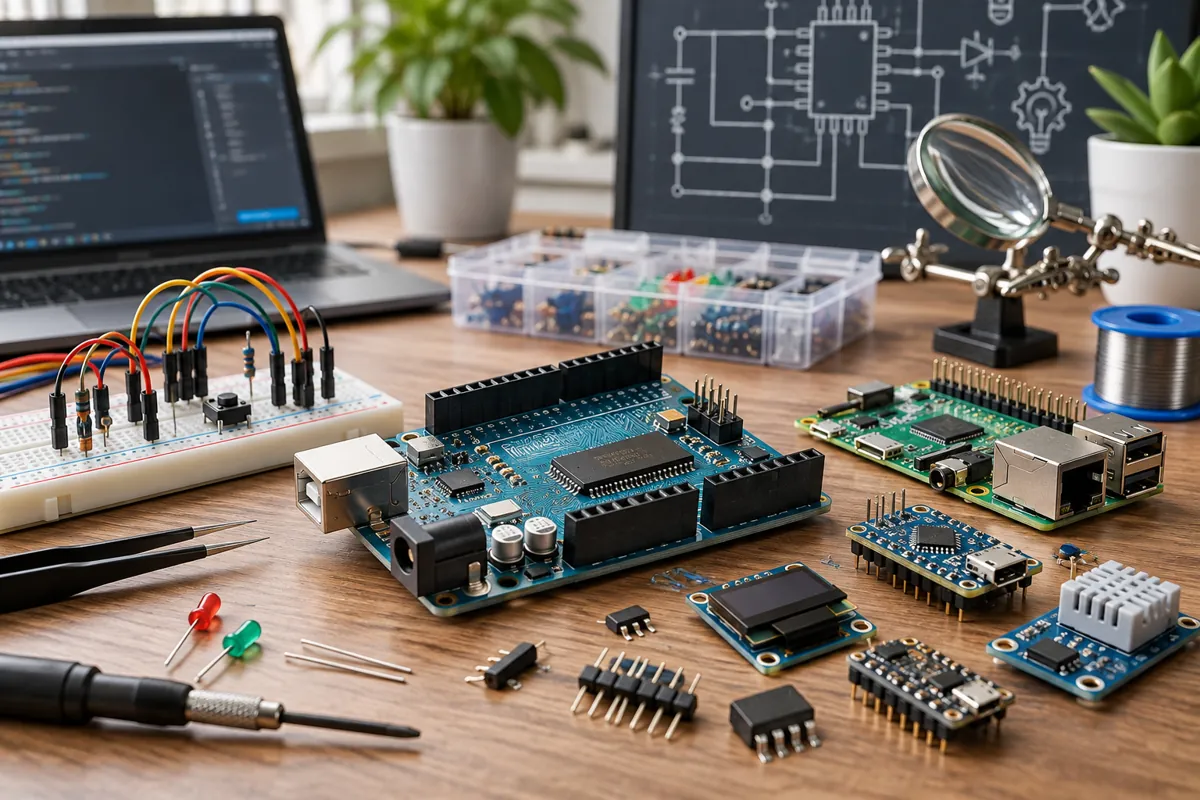
Hardware & Microcontrollers
Arduino, Raspberry Pi, sensors and embedded projects
Introduction
Hardware and microcontrollers form the backbone of modern electronic projects and systems. They enable automation, data acquisition, control mechanisms, and communication interfaces in everything from household appliances to industrial machinery. Understanding their essentials has become critical for engineers, hobbyists, and developers aiming to innovate or optimize existing solutions.
With rapid advancements in technology over the past decade, the number of available microcontroller options has expanded significantly. From simple 8-bit units to powerful 32-bit processors with integrated wireless capabilities, the landscape offers tools to suit nearly any application. Gaining a firm grasp of core concepts, functioning principles, and best practices ensures effective use of these components and avoids common pitfalls.
Definition and core concepts
A microcontroller is a compact integrated circuit that contains a processor core, memory, and programmable input/output peripherals. Unlike general-purpose processors designed for computers, microcontrollers are built for dedicated control tasks within embedded systems. They are self-contained units capable of executing preloaded instruction sets to manage specific functionalities.
Core concepts associated with microcontrollers include architecture, peripherals, and programming. Architecture determines how the processor handles data and instructions; popular architectures include ARM Cortex-M, AVR, and PIC. Peripherals such as timers, analog-to-digital converters (ADC), and communication interfaces (UART, I2C, SPI) extend their control capabilities. Programming typically involves writing firmware in low-level languages like C or assembly to control hardware components efficiently.
Microcontrollers are distinguished by their size, power consumption, and I/O pin availability. Models range from small units with fewer than 10 pins designed for simple sensors, to complex chips with over 100 pins supporting multiple communication interfaces, external memory, and advanced automation features. They serve as the core processing units in devices like thermostats, drones, medical devices, and robotics systems.
How it works
Microcontrollers operate by executing instructions stored in their internal memory, typically non-volatile flash or ROM. When powered on, they begin executing code from a predefined address, often written by the user to perform specific tasks. The processor interprets instructions cycle-by-cycle, controlling the flow of data between internal registers, peripherals, and external devices.
Communication with external hardware occurs through various interfaces. Digital input/output pins detect signals from sensors or switches, while output pins control actuators like motors or LEDs. Analog signals from sensors are converted into digital data via ADC modules integrated within the microcontroller. This data is processed according to the firmware logic, which may involve timers, interrupts, or direct memory access (DMA).
Microcontrollers utilize clock signals to synchronize operations. Typically, they run on internal oscillators or external crystals ranging from 8 MHz to 80 MHz, influencing processing speed and power consumption. The firmware can be structured into loops or interrupt routines, allowing the microcontroller to respond promptly to real-time events, such as a button press or sensor alert.
Power management is integral to operation; many microcontrollers feature sleep modes that reduce current draw to microamp levels when inactive. This capability is key in battery-powered devices, extending operational life from hours to years depending on usage and hardware design.
Practical application
Microcontrollers find use in a vast array of practical scenarios. In consumer electronics, they enable features like touch screen interfaces, power management, and wireless connectivity in smartphones and smart home devices. For instance, the ESP32 microcontroller offers Wi-Fi and Bluetooth capabilities, making it suitable for home automation projects.
In industrial settings, microcontrollers control machinery and monitor environmental conditions. PLCs (programmable logic controllers) rely on microcontroller-based hardware to automate manufacturing lines, manage safety systems, or track machinery health through sensors. These systems often operate continuously, with resilience and real-time response being vital.
Robotics heavily depends on microcontrollers. They coordinate motor control, sensor feedback, and communication between various modules. An Arduino Uno, based on the ATmega328P, is commonly used in hobbyist robots for tasks such as line following, obstacle avoidance, and remote control via Bluetooth modules.
Automotive applications use microcontrollers for engine management, airbag systems, and infotainment units. These systems require high reliability and real-time data processing, often involving multiple microcontrollers communicating over CAN bus networks.
Home automation devices, such as smart thermostats, security cameras, and voice assistants, leverage microcontrollers for local processing and wireless communication. The Raspberry Pi Pico, utilizing the RP2040 microcontroller, is popular for DIY projects due to its affordability and versatility.
Environmental monitoring systems utilize microcontrollers to collect data from temperature, humidity, and air quality sensors. This data can then be transmitted via LoRa or Wi-Fi modules to cloud services for analysis, enabling proactive maintenance or alerts.
Common mistakes
A frequent error involves misconfiguring I/O pins or choosing incompatible voltage levels. Many microcontrollers operate at 3.3V but can tolerate 5V inputs with certain precautions. Failing to verify voltage tolerances can lead to hardware damage or unreliable operation.
Using improper power supply design is another mistake. Sudden voltage dips or noise can cause the microcontroller to reset or malfunction. Employing decoupling capacitors—typically 0.1 μF ceramic disks near power pins—is essential to stabilize the supply line.
Developers often neglect optimization of firmware and neglect interrupt management. Excessive polling of sensors or inefficient code streams can lead to increased power consumption and missed real-time events. Proper use of interrupts and sleep modes enhances responsiveness and battery life.
Expert recommendations
Choosing the right microcontroller depends on the application requirements. For projects demanding low power consumption, microcontrollers like the STM32L series offer ultra-low power modes. For high processing needs, ARM Cortex-M7 based units provide over 600 DMIPS for complex calculations.
When designing hardware, plan for modularity by separating power, signal, and ground planes. Using dedicated ground planes minimizes electromagnetic interference (EMI) and reduces noise, especially in high-frequency applications.
Firmware development should follow best practices such as using watchdog timers to recover from unexpected errors and implementing robust error handling routines. Utilizing development environments like PlatformIO or Arduino IDE simplifies debugging and deployment.
Security considerations should not be overlooked. For IoT applications, incorporating secure bootloaders, encrypted communication protocols (like TLS), and firmware update mechanisms helps protect devices from malicious attacks or unauthorized access.
Conclusion
Microcontrollers are fundamental components that enable control and automation across multiple industries. Their core concepts, from architecture to peripherals, serve as the foundation for designing reliable embedded systems. Recognizing the common pitfalls and adhering to expert guidance improves project success and device longevity.
Continuous advancements in microcontroller technology provide more processing power, connectivity options, and energy efficiency. Staying informed about new models and best practices ensures optimized performance for current and future applications.